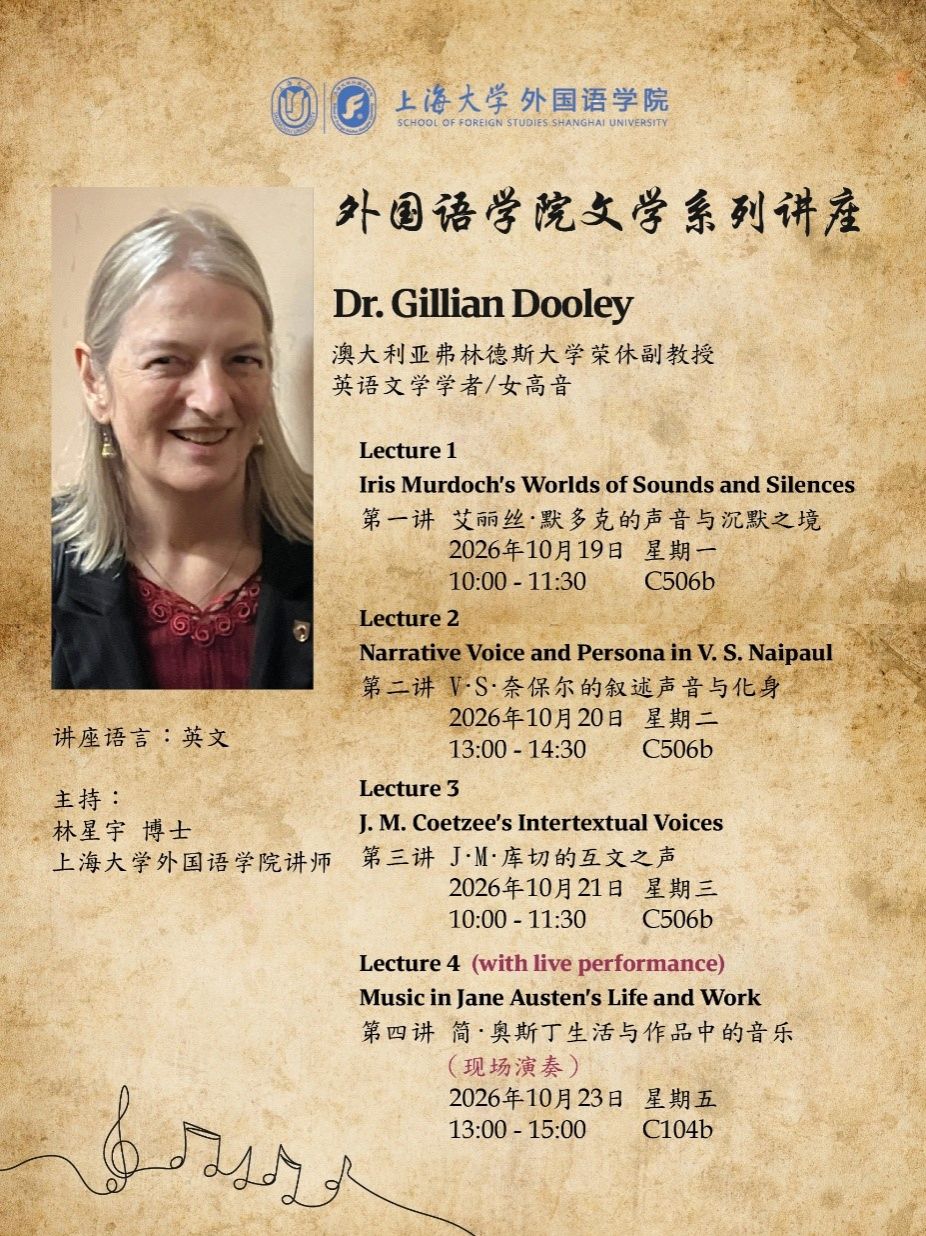
主讲人简介:
Gillian Dooley is an Honorary Associate Professor in English Literature, having retired from Flinders University Library, where she had been Special Collections Librarian 1999-2015 and Publishing Support Librarian 2016-2017, in May 2017. She graduated from Flinders with a PhD in English in 2001. She was the founding general editor of the Flinders Humanities Research Centre's electronic journal Transnational Literature from 2008-2018, and was founding co-editor of Writers in Conversation 2014-2020. She has published several monographs and scholarly editions and more than 100 journal articles and book chapters. Her research interests include the writers J.M. Coetzee, Iris Murdoch, V.S. Naipaul, Jane Austen, and maritime explorer Matthew Flinders. She has presented a number of keynotes and public lectures, in person and online, all over the world. Her particular interest is in music and literature, and as a singer she often organises and performs in programs of music with literary themes. In 2023 and 2024 she was a visiting fellow at the Institute of Advanced Studies in the Humanities at Edinburgh University. A major project completed recently is the detailed cataloguing of the complete music collection of Jane Austen and her family, and her book She Played and Sang: Jane Austen and Music was published by Manchester UP in 2024. She has been a regular book reviewer for various journals and magazines, including Australian Book Review.
Lecture 1 Iris Murdoch’s Worlds of Sounds and Silences
第一讲 艾丽丝·默多克的声音与沉默之境
2026年10月19日 星期一 10:00 – 11:30 C506b
In Iris Murdoch’s novels, when sounds or silences are described, it is rarely just a matter of scene-setting – it almost always provides insight into the state of mind of the character who is experiencing it. She orchestrates her sound-worlds as much with ambient noise, birdsong and human sounds overheard, as with actual music, and silence is often important not just as absence of sound, but as an almost palpable quality in itself: her silences come in different qualities, moods and textures.
Gillian Dooley will look at how Murdoch uses silence both as a phenomenon and an idea in her novels, in particular The Sacred and Profane Love Machine and Under the Net. Dooley will also discuss Murdoch’s descriptions of what characters sound like (focusing especially on The Bell and Henry and Cato), as well as the characters’ voices and accents, and how this affects their interactions and the atmosphere of each novel.
Lecture 2 Narrative Voice and Persona in V.S. Naipaul
第二讲 V·S·奈保尔的叙述声音与化身
2026年10月20日 星期二 13:00 – 14:30 C506b
Naipaul, 2001 Nobel Laureate in Literature, enrages many readers with his seemingly misogynistic attitudes. He often made disparaging remarks in public forums about women, and female writers in particular, and the uncritical descriptions of gendered violence in his novels have attracted much attention from literary scholars. Naipaul’s unique literary persona appears to invite controversy, despite his mastery of English prose and his skill at depicting characters and social milieux. It is often difficult to tell where his sympathies lie when he writes about complex interpersonal relations.
Gillian Dooley will begin with an overview of Naipaul’s writing career, and then look at the narrative voice and persona in some of the more perplexing passages in his novels where he describes gender-based violence, especially in The Mystic Masseur, Guerrillas, and A Bend in the River.
Lecture 3 J. M. Coetzee’s Intertextual Voices
第三讲 J·M·库切的互文之声
2026年10月21日 星期三 10:00 – 11:30 C506b
J. M. Coetzee, 2003 Nobel Laureate in Literature, is well known for drawing on intertexts from the long tradition of Western literary culture in his novels. It is more unusual to find him characterised as a comic writer, but there is a deep vein of humour and irony running through his oeuvre.
In this lecture, Gillian Dooley will look at Coetzee’s novel Foe as an intertextual work, and the interactions between his novels Slow Man and Elizabeth Costello. She will then move on to the ‘strong opinions’ voiced in novels such as Elizabeth Costello and Diary of a Bad Year to examine their relationship with personal statements Coetzee has made in letters and interviews. Dooley will also discuss his approach to comedy which, despite his reputation, is never far from his work, and the place in his writing of his own consciousness of being a diasporic subject in a rapidly changing world.
Lecture 4 Music in Jane Austen’s Life and Work (with Live Performance)
第四讲 简·奥斯汀生活与作品中的音乐(现场演奏)
2026年10月23日 星期五 13–15 C104b
Music played a part in Jane Austen’s life: her letters reveal a dislike for public concerts, appreciation of people who are honest about their lack of musical taste, and sometimes genuine enjoyment of a superior performance. Some of these attitudes are also displayed in her novels, but there are subtleties and ambiguities in the way she uses music and musicianship to illuminate the characters, sharpening in various ways the differences between them, and adding extra facets to her portraits of young women in that crucial time of their lives just before marriage.
This event will be in two parts. Firstly, Gillian Dooley will talk about the way Austen uses music and musicianship in her most famous novel, Pride and Prejudice – how it illuminates but does not define her characters. In the second section, Dooley will discuss the Austen family music collections, particularly the music manuscripts in Jane Austen’s hand, and give a live performance of songs and piano music drawn from them.
